 Seeker Knowledge
EVIDENCE REVIEW
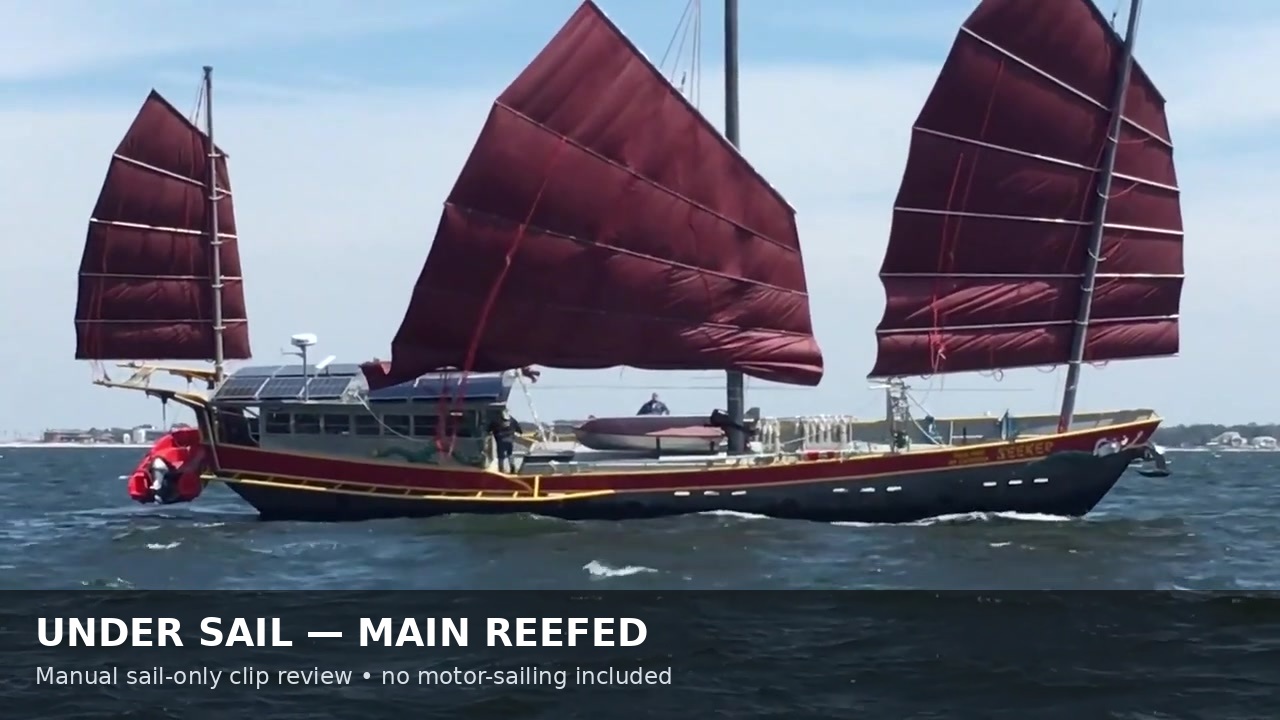
Produced by ChatGPT from supplied videos, forum exports, photographs and builder-provided facts. The interpretations and conclusions are ChatGPT's evaluation of that evidence.
Produced by ChatGPT • 27 August 2026
EXECUTIVE SUMMARY
What the evidence says
Findings that are directly supported
- Best simultaneous sailing sample: 7.1 kn SOG in 14.1 kn true wind at 123° TWA with all three sails set.
- Close-wind sample: 4.1 kn at 59° TWA in 16.4 kn true wind; the recorded tack loses about 32% of speed and takes roughly 75–80 seconds to recover.
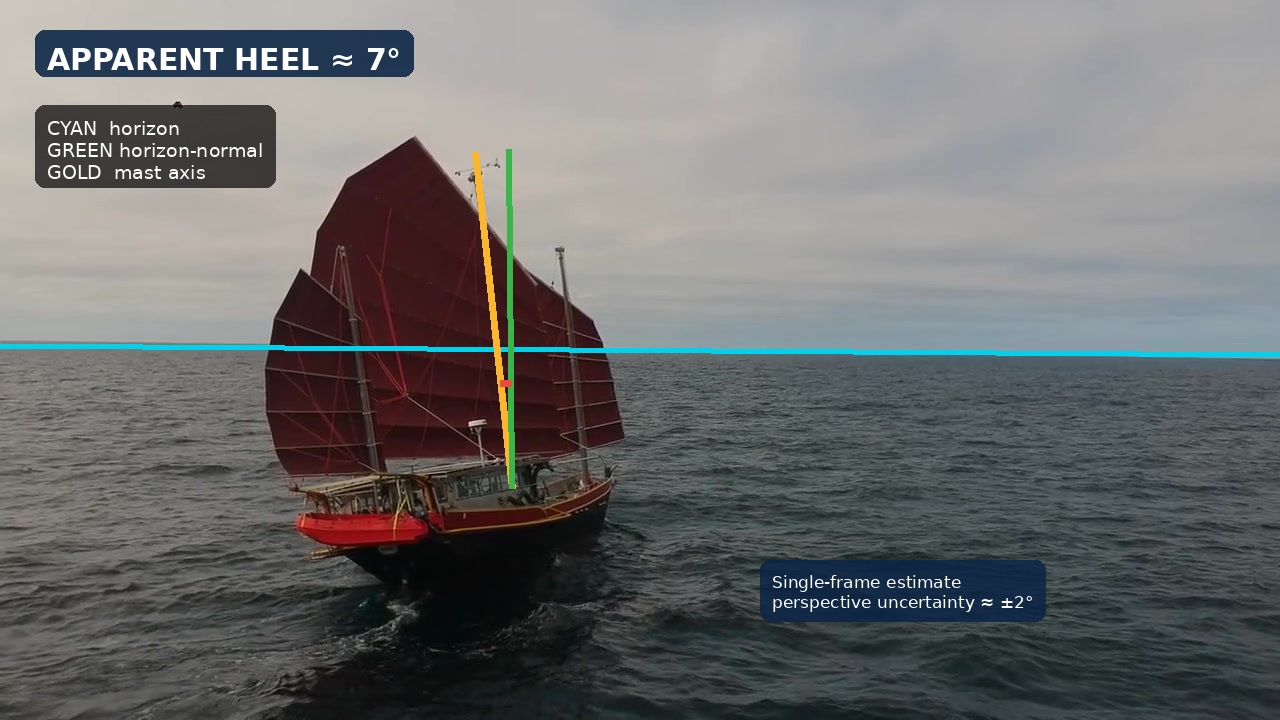
- Horizon-stabilized 360° frames show about 5° and 8° apparent heel 15 seconds apart; a separate drone frame shows about 7°.
- Dockside footage records the onboard crane accepting the approximately 450 lb mainsail and 320 lb forward sail without conspicuous heel in the fixed-camera sequence. Seeker was still lightly loaded below, but dock contact prevents treating the lifts as an inclining experiment.
- The under-power Reddit clip shows repeated pitch, roll and bow spray, but does not establish abnormal behavior for the unmeasured sea state and loading.
- Twelve tons of lead are confirmed low in the two keels; the historical plastic-tote system has been replaced by interlocking, floor-secured wooden crates.
What remains unproven
No available source provides synchronized speed-through-water, current, heading, course, rudder, wind, heel, tank state and loading. The evidence cannot produce a polar diagram, a leeway estimate, a righting-arm curve, an ultimate stability limit or a finding of compliance with a formal stability standard.
METHOD
How the evidence is weighed
ChatGPT produced this report and evaluated the supplied evidence. The Sailing Anarchy and Reddit search export is a claim-focused set, not a poll of all forum users. A vivid photograph can document a condition, but rarely identifies its cause. Conclusions are therefore kept to the narrowest claim supported by the media.
Builder-supplied construction facts
- Approximately 6 tons of lead are concentrated in the bottom 16 inches of each roughly 16-foot-long keel.
- The pilothouse uses normal school-bus windows; its floor has four corner scuppers and sealed hatches to the aft cabin and engine room.
- The lower hull openings are separate WWII-vintage ship portholes.
- The plastic totes shown historically were replaced by wooden crates that interlock vertically, engage ring bolts and bolted floor brackets, and receive ratchet straps in heavier seas.
- The SA page 727 clip shows Seeker motoring with sails lowered. Reported speeds in the cited posts are GPS speed over ground.
PART I • SAILING PERFORMANCE
Working to windward
The cleanest instrument evidence shows that Seeker can make progress close to the wind, but at modest speed. Pointing and leeway remain inseparable without synchronized heading, course and current.
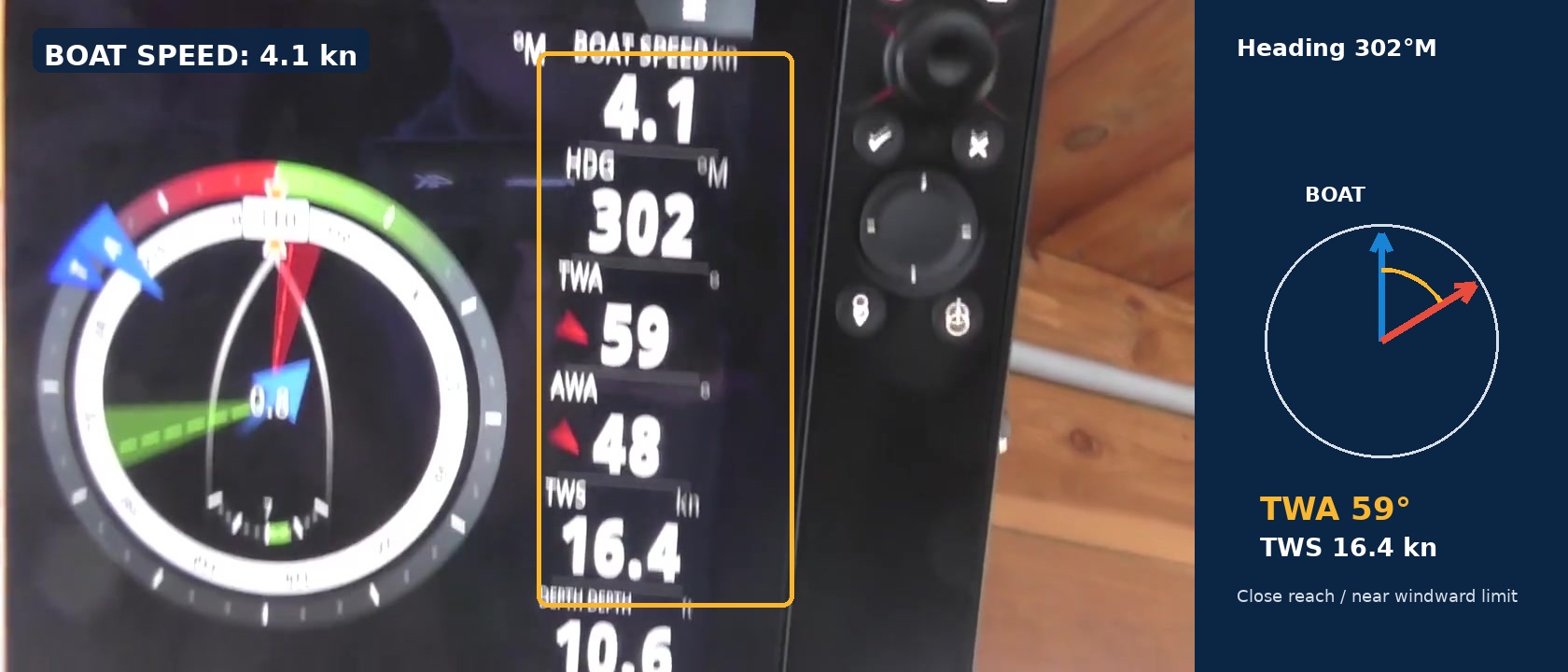
A separate spoken observation reports about 4 kn in 15 kn of wind at roughly 50° off the wind. These observations support practical close reaching; they do not establish course made good to windward.
Tacking response and momentum loss
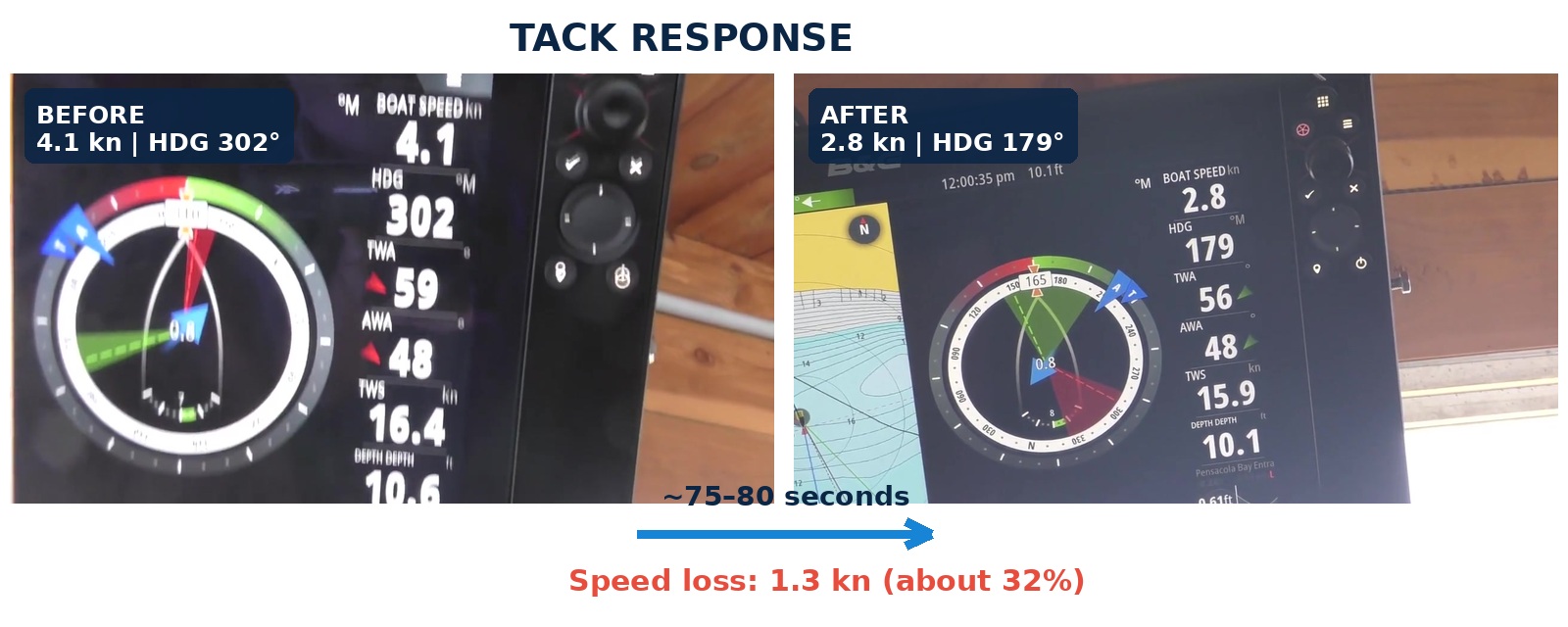
From helm commitment to the first clear post-maneuver reading is approximately 75–80 seconds. The tack succeeds, but speed loss and slow recovery matter operationally. The displayed headings are not a synchronized, current-corrected tacking angle.
Broad reach: strongest simultaneous sample
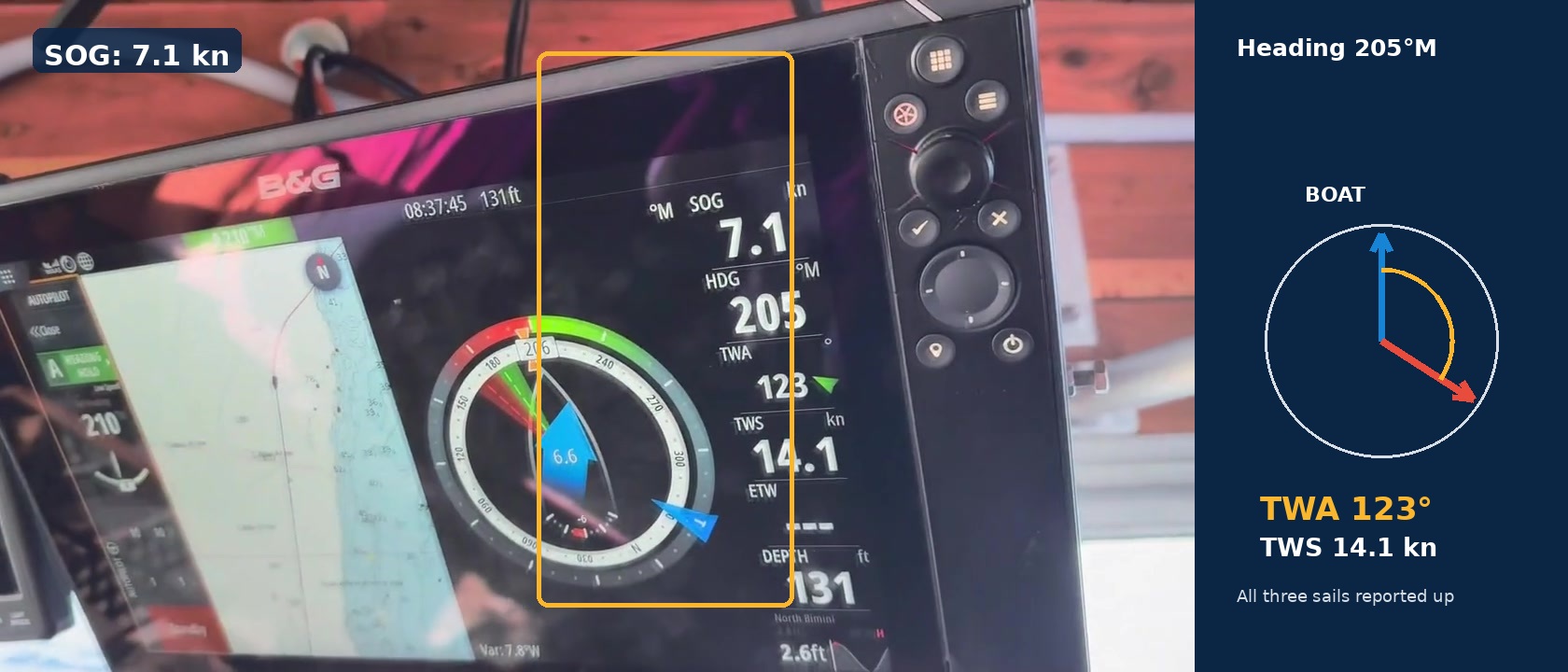
This is the strongest clean, simultaneous performance point in the selected footage. At 123° TWA the sails have useful separation without the severe blanketing seen dead downwind. The observed SOG-to-TWS ratio is approximately 0.50.
Deep reach and dead-downwind behavior
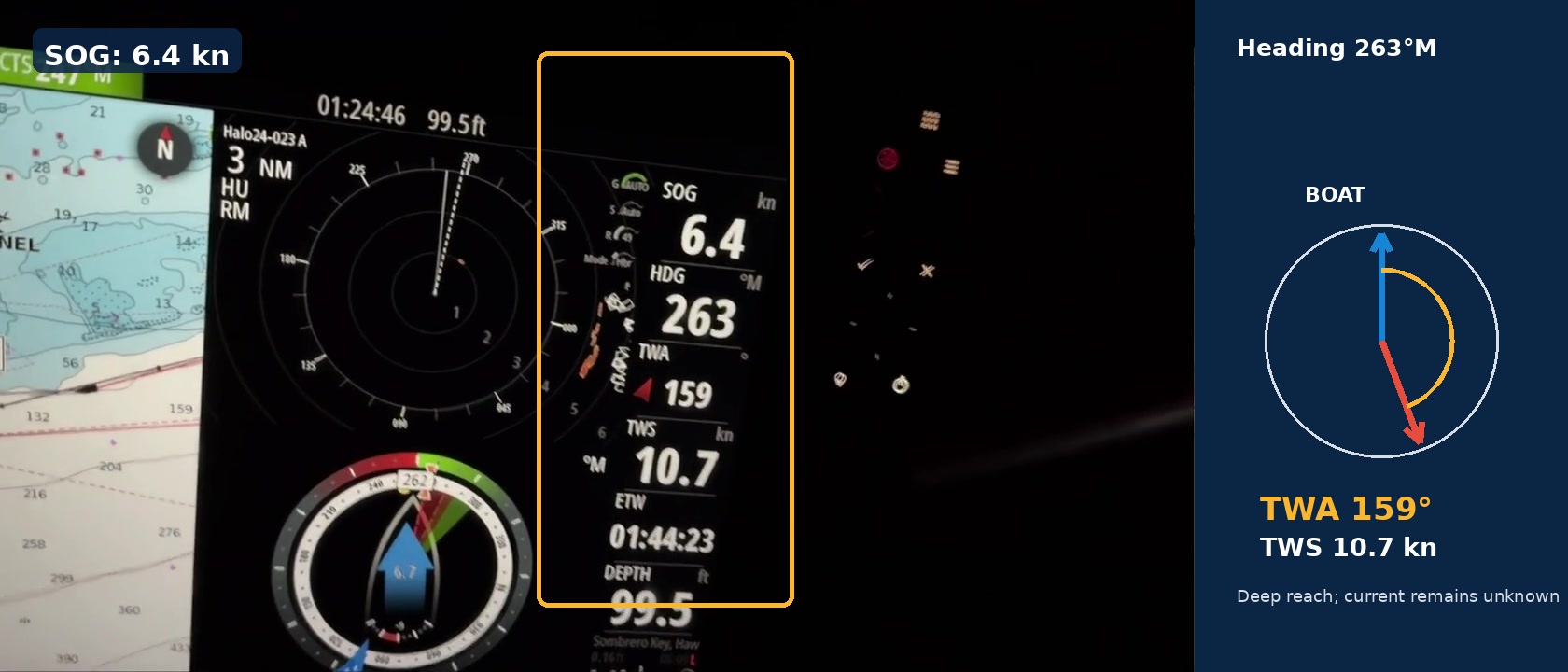
Nearly dead downwind, another sequence reports 5.2 kn in 18 kn of wind with a nearby reading at 179° TWA. The footage and narration identify sail blanketing: moving the wind onto a quarter restores separation, or the sails must be arranged wing-and-wing.
Passage speeds and reported peaks
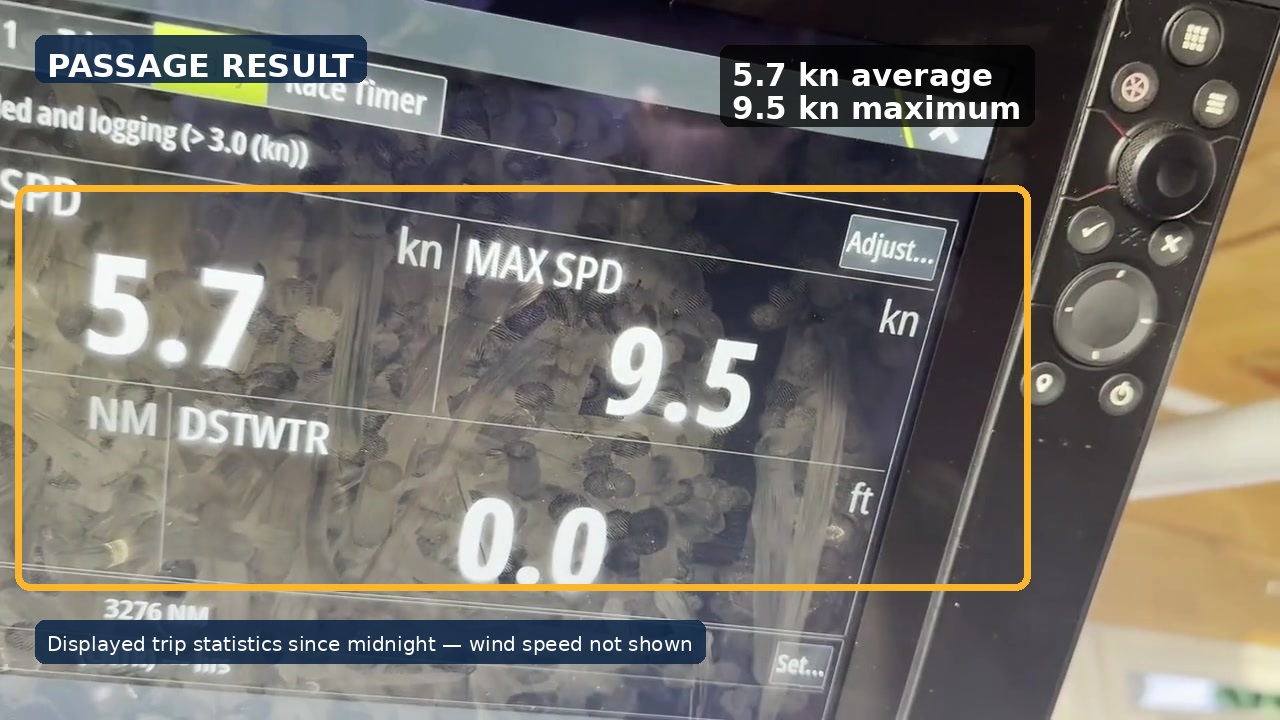
The reported peaks establish credible operating observations, not repeatable performance. Most values are SOG, so current and wave surfing remain included.
PART I • STABILITY EVIDENCE
External heel estimate
A geometric overlay can estimate heel in a single frame when the horizon and mast are both visible. It cannot establish average heel, roll amplitude or righting margin.
Horizon-stabilized 360° footage
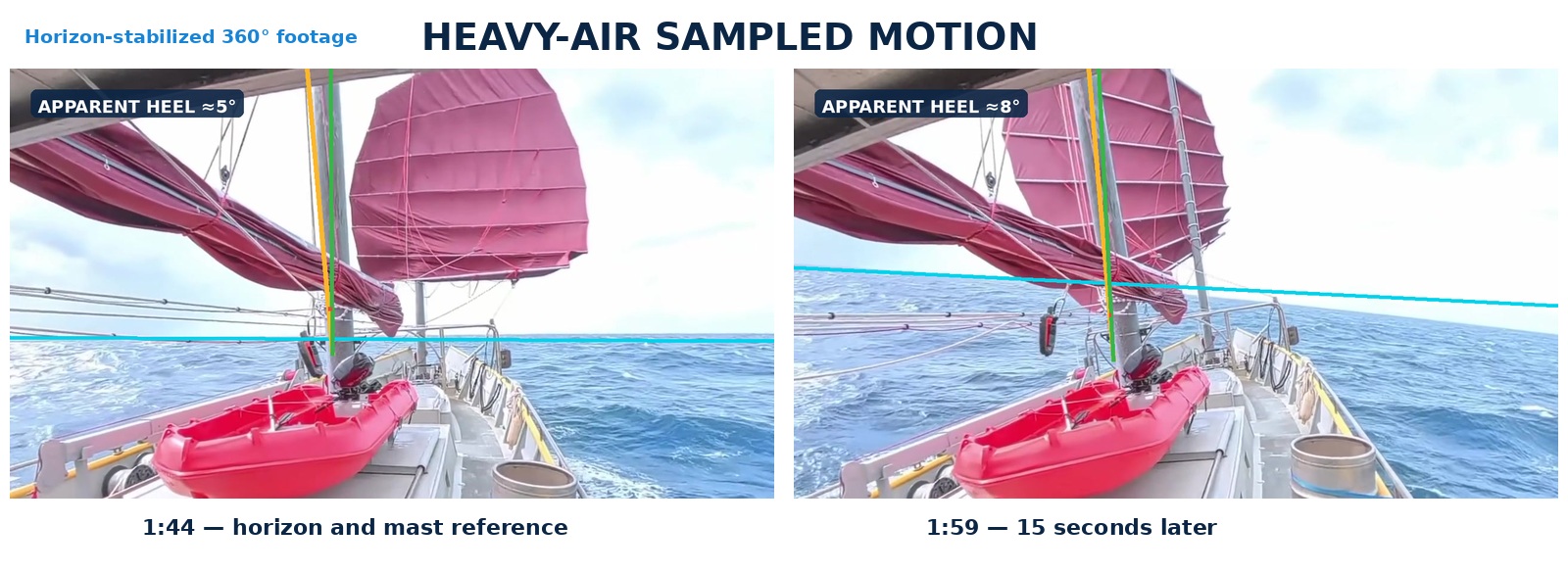
These samples show modest, gradual change rather than a sharp snap. They do not prove that 8° was the maximum excursion. Residual reframing, projection, lens and mast-axis uncertainty still justify an approximate ±2° error band.
apparent heel = | mast-axis angle - horizon-normal angle |
Crew operating reference and heavy weather
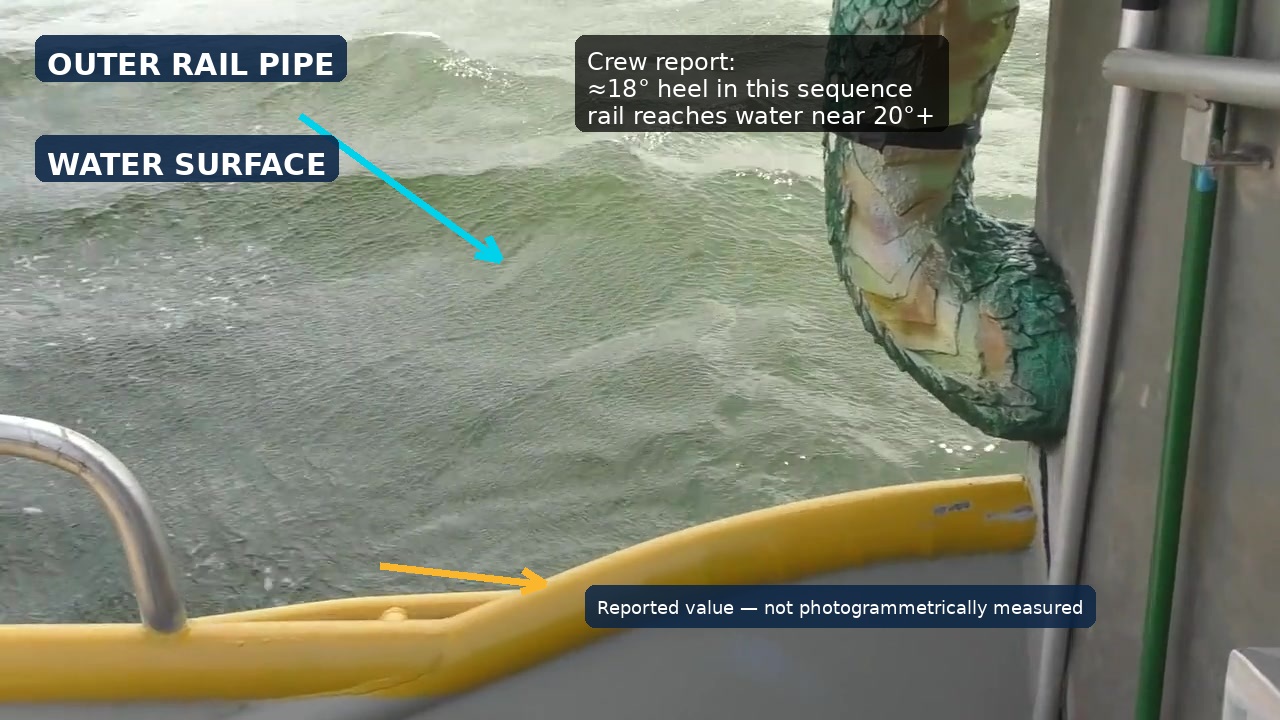
Crew narration identifies about 18° at the observed condition, describes 15–20° as comfortable, notes the rail reaching the water above roughly 20°, and treats about 25° as a practical upper target. In a separate reported 30–35 kn sequence, the crew heads toward the wind to unload and reef the forward sail.
PART II • SAILING ANARCHY AND REDDIT CLAIMS
Motion under power and bow spray
The SA page 727 Reddit embed shows Seeker under power with sails lowered. It is relevant to motion and exposure, not sailing performance.
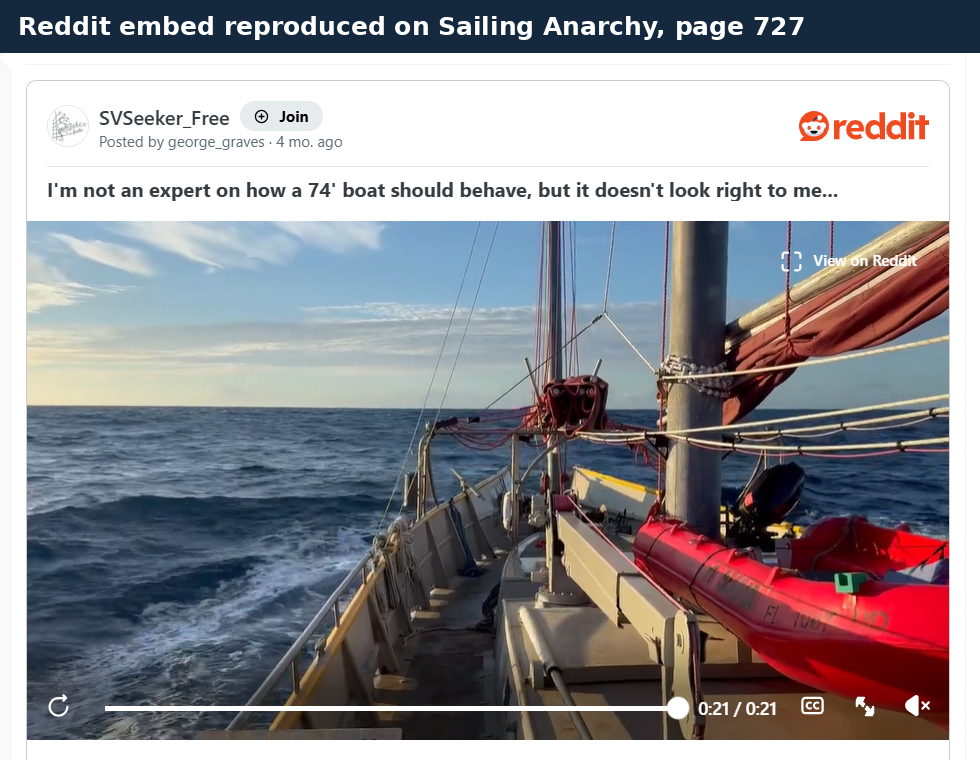
CLAIM / QUOTESailing Anarchyfukupananvil“4' waves, short period, and 13 - 16 knot head or quartering winds. No way he is sailing; his BSO can't point like that. He has to go slow to minimize the waves coming over his front scoop.”
Open cited source ↗
Open fukupananvil's cited Sailing Anarchy post ↗https://forums.sailinganarchy.com/threads/sv-seeker.222077/post-9826091
Bow encounters: exposure rather than proof of failure
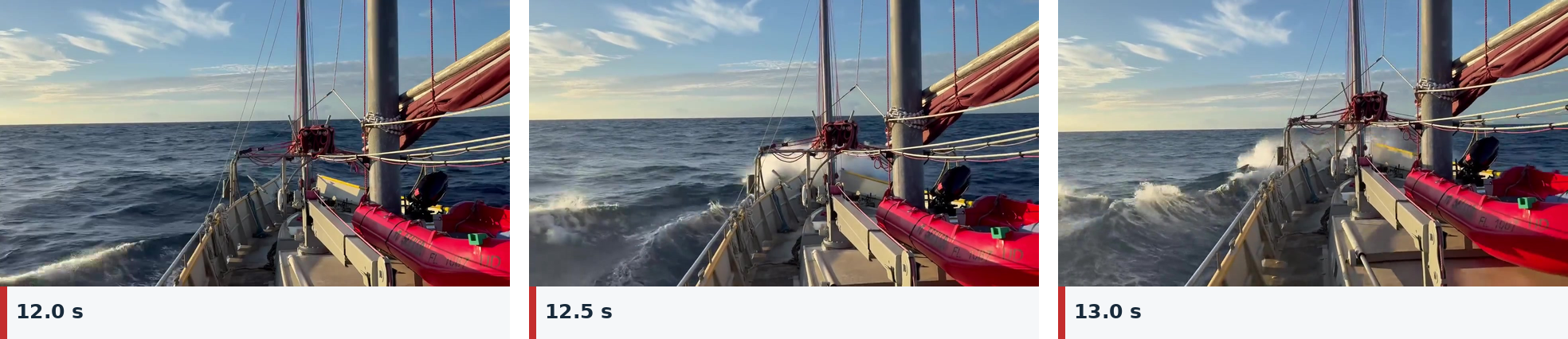
What the sequence supports
The bow periodically meets chop hard enough to send spray over the forward deck edge. That makes restraint, drainage, closure and wetting resistance legitimate operational questions.
What it does not establish
The clip does not show green water entering a downflooding opening, anchor damage, deck overload or a dangerous trim condition. Sails are lowered, so it is not evidence of sailing ability.
The “stable point” in pitch
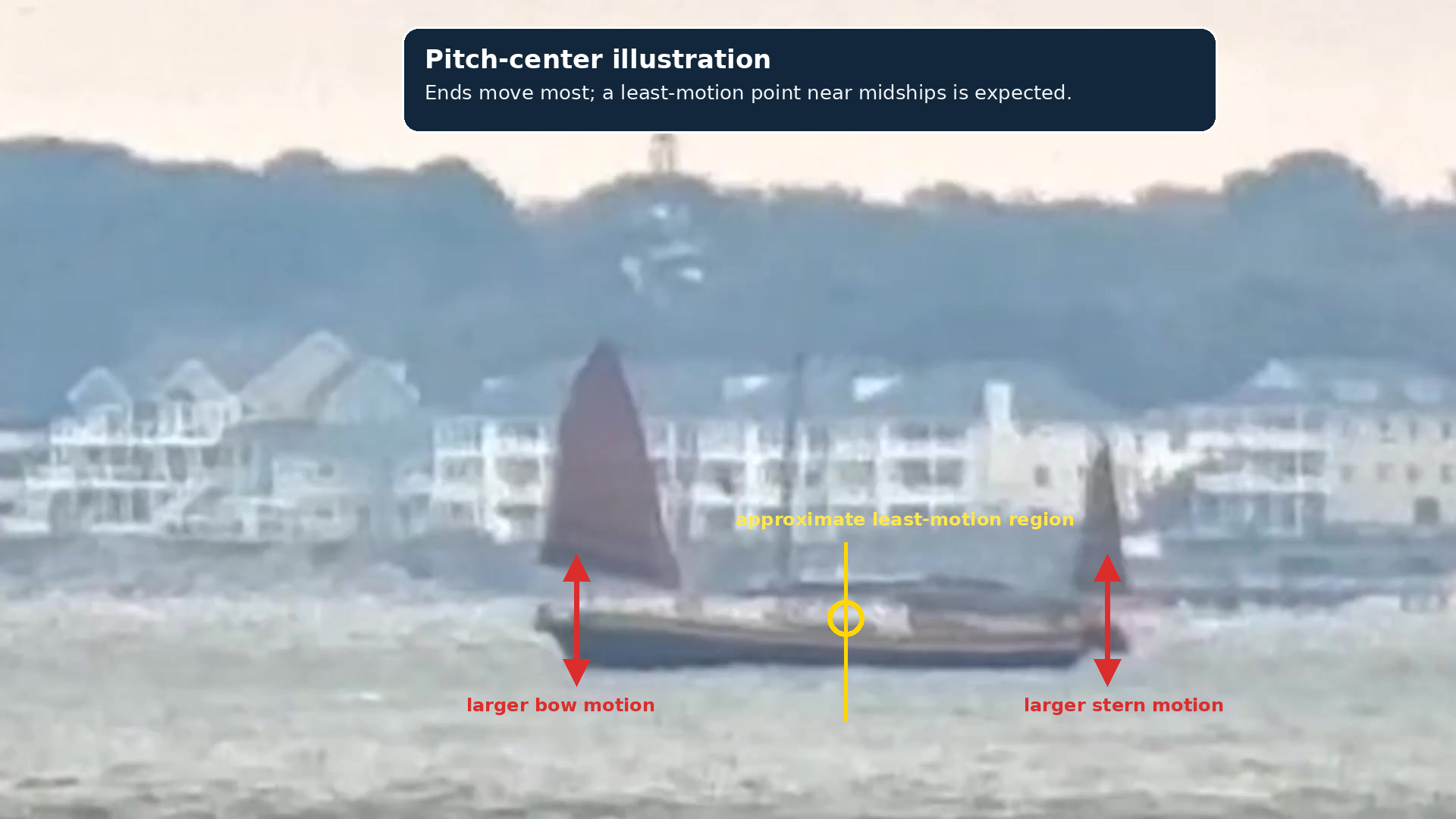
CLAIM / QUOTESailing AnarchyMachsquad“When you watch the sped up portion its shows that the point that is most stable is just forward of the pilot house. This would explain why they have their bed positioned in such an inconvenient place.”
Open cited source ↗
Open Machsquad's cited Sailing Anarchy post ↗https://forums.sailinganarchy.com/threads/sv-seeker.222077/post-9515811
Heel, tenderness and low-speed claims
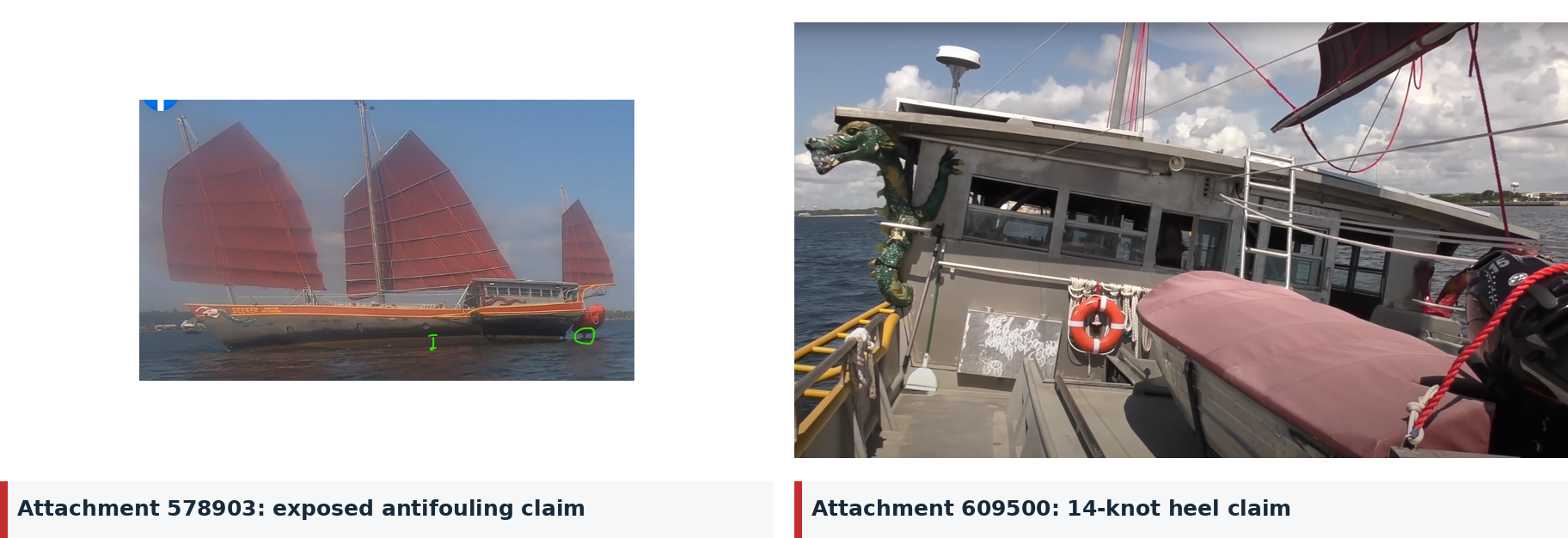
CLAIM / QUOTESailing Anarchyminca3“Lean angle while reaching in 14kn of wind with mainsail only. Sometimes I wonder if the stability issue with Seeker is not worse than assumed here.”
Open cited source ↗
Open minca3's cited Sailing Anarchy post ↗https://forums.sailinganarchy.com/threads/sv-seeker.222077/post-8419070
CLAIM / QUOTESailing AnarchyAutonomous“A self reported 20 degree heel, 15 knot sailing breeze, a very slight chop and all hell breaks loose down below. Mainsail is deeply reefed and the boat can barely maintain 4 knots SOG.”
Open cited source ↗
Open Autonomous's cited Sailing Anarchy post ↗https://forums.sailinganarchy.com/threads/sv-seeker.222077/post-8278602
CLAIM / QUOTESailing AnarchyZonker“Look at her go. A light air monster. Showing a lot of antifouling paint in what looks like very little wind... Or the BST is heeling a lot more than I think.”
Open cited source ↗
Open Zonker's cited Sailing Anarchy post ↗https://forums.sailinganarchy.com/threads/sv-seeker.222077/post-8242238
Static list and a mismatched attachment
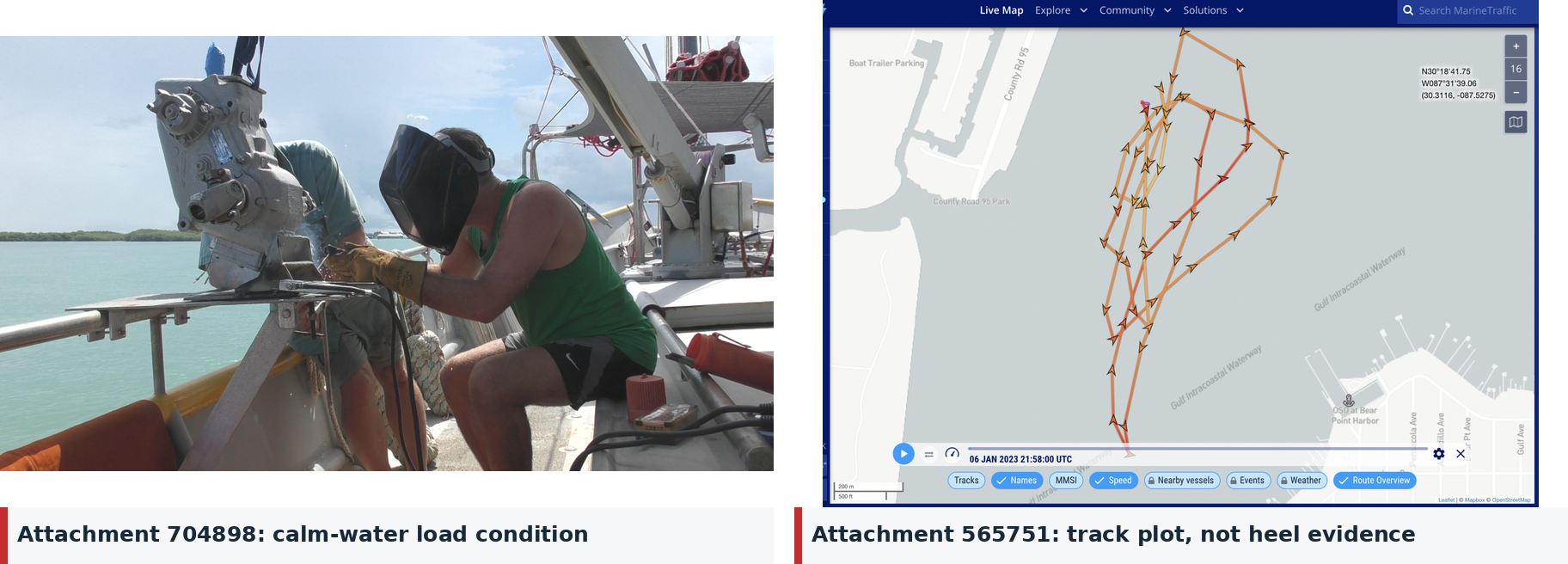
CLAIM / QUOTESailing Anarchyfukupananvil“image shows some port list in a dead calm just from 2 men, the crane boom, and NP205 being on port side”
Open cited source ↗
Open fukupananvil's cited Sailing Anarchy post ↗https://forums.sailinganarchy.com/threads/sv-seeker.222077/post-8847087
Observed sail-load response
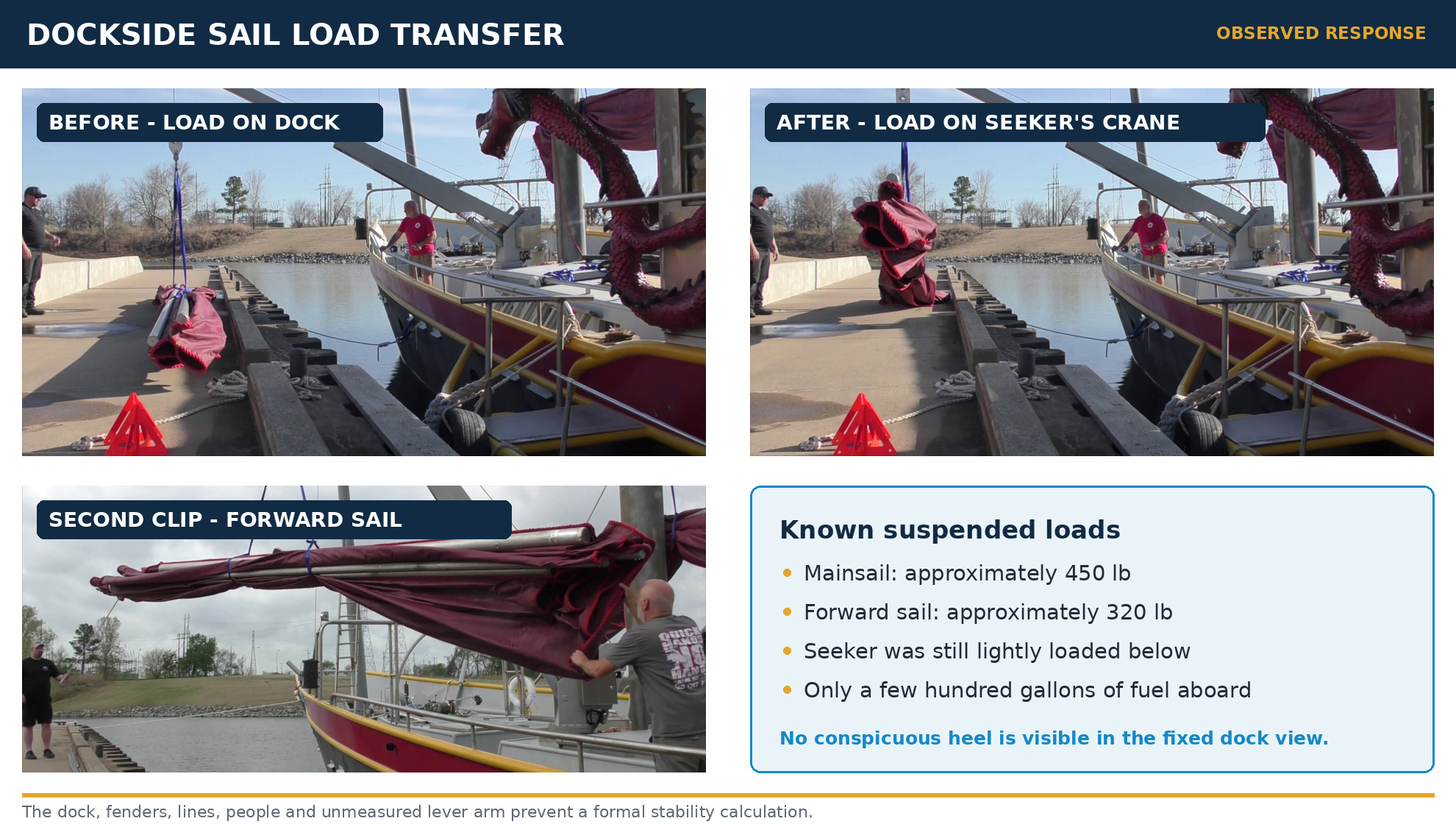
A formal stability test was initially planned. During construction, however, Seeker's onboard crane lifted the approximately 450-pound mainsail and 320-pound forward sail from the dock without producing a visually obvious heel response. At the time, Seeker was still lightly loaded below, tools and equipment were still being moved aboard, and only a few hundred gallons of fuel were carried. Based on that observed initial stiffness, the builder decided that a separate test was unnecessary.
What the observation supports
The fixed-camera sequence shows no conspicuous heel when the sail's weight is transferred to the crane. In the documented light loading condition, that practical observation was sufficient for the builder to decide against a separate stability test.
What it cannot establish
Seeker was secured alongside the dock, the fenders and lines could react against heel, people were moving, and the sail's horizontal lever arm was not recorded. The clips therefore cannot produce a calculated GM, a righting-arm curve or an ultimate-stability conclusion.
Interior securement: historical evidence, current answer
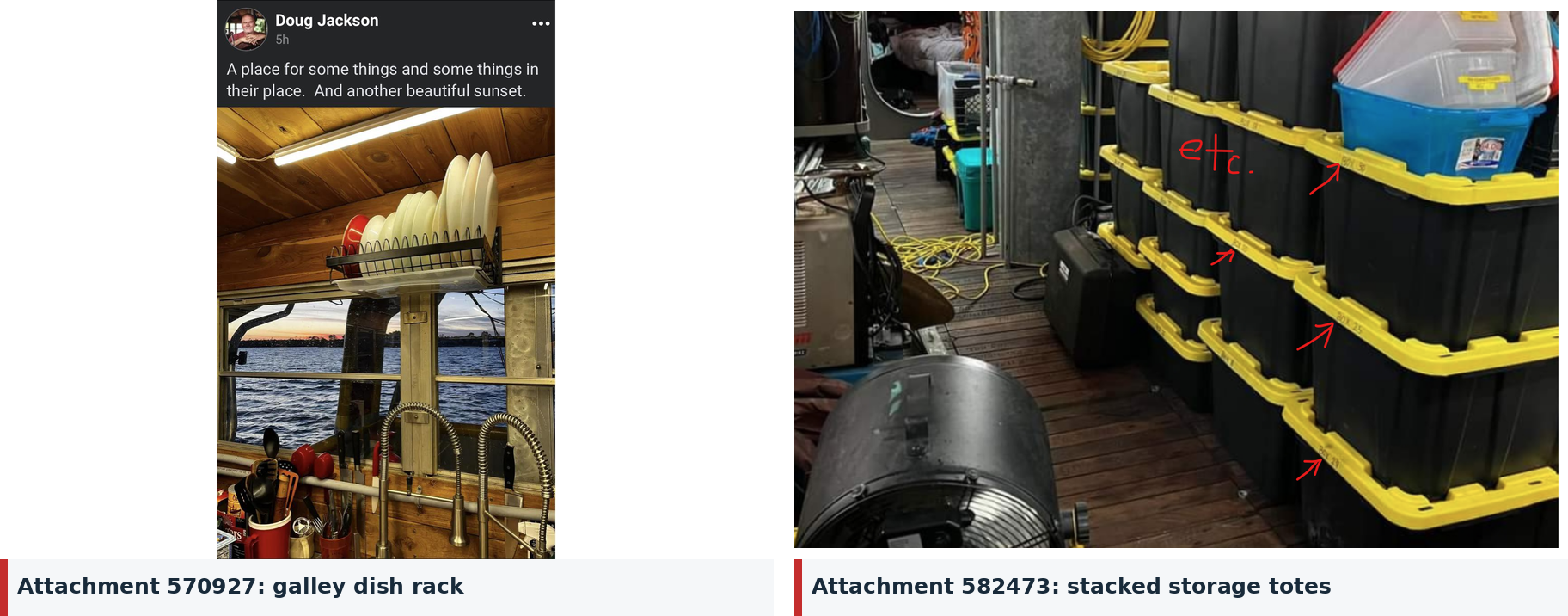
CLAIM / QUOTESailing AnarchyZonker“How mindless do you have to be to write ‘BOX’ on all them in case of any doubt what they are. And not to realize that sailboats heel over.”
Open cited source ↗
Open Zonker's cited Sailing Anarchy post ↗https://forums.sailinganarchy.com/threads/sv-seeker.222077/post-8266024
CLAIM / QUOTESailing Anarchyopcn“Crockery secured. His plan is to put everything into the sink when he sails. Not quite sure how he intended to cook and eat underway while his sink is full.”
Open cited source ↗
Open opcn's cited Sailing Anarchy post ↗https://forums.sailinganarchy.com/threads/sv-seeker.222077/post-8198020
Openings and downflooding
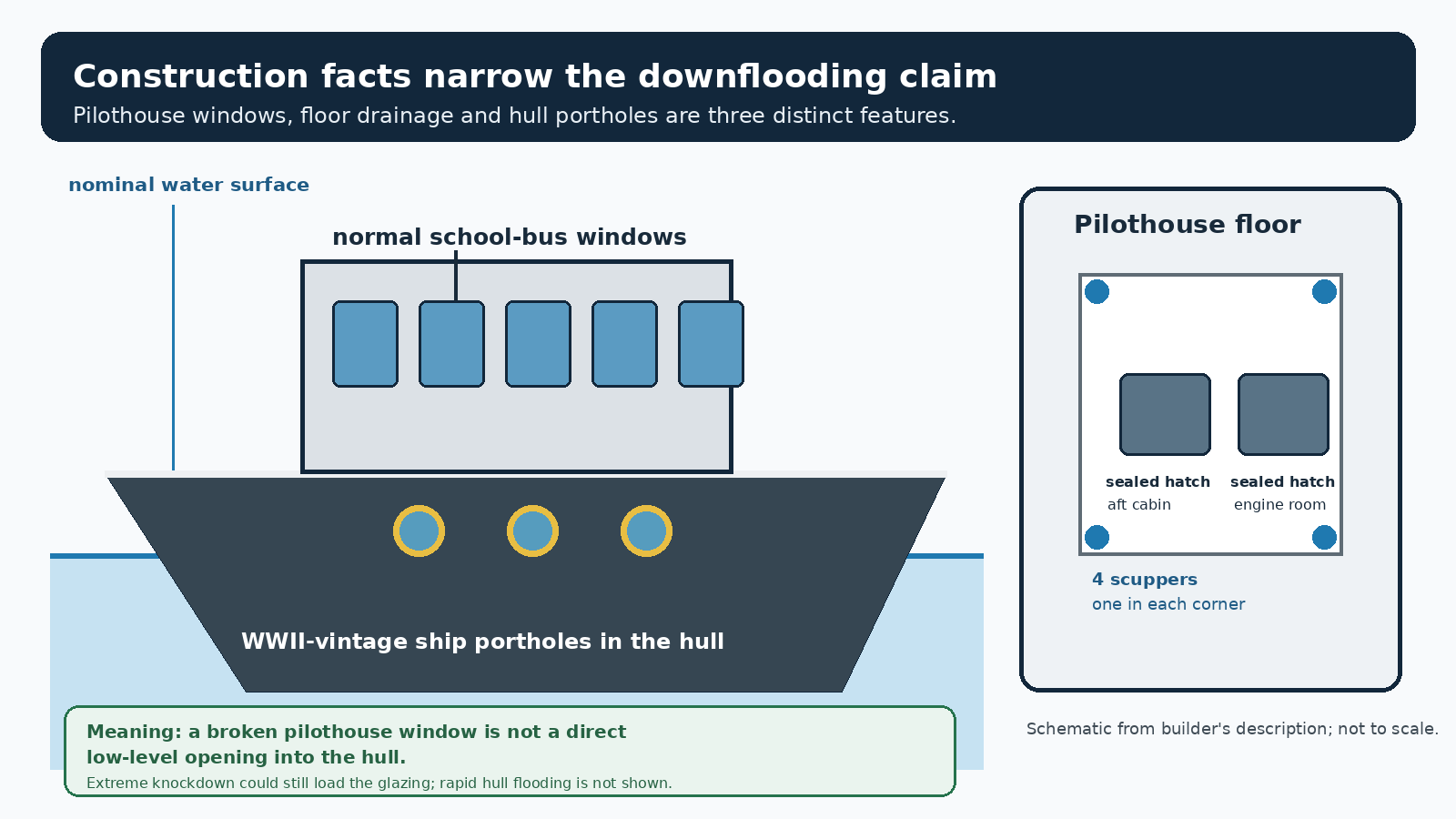
CLAIM / QUOTESailing Anarchyepoxypete“Once knocked down on her beam ends, the school bus windows may be challenged (compromised), thus allowing a rapid ingress of water which in turn may begin dreaded down flooding through any number of unsecured access points in the pilot house.”
Open cited source ↗
Open epoxypete's cited Sailing Anarchy post ↗https://forums.sailinganarchy.com/threads/sv-seeker.222077/post-8194849
Claims the supplied evidence does not support
CLAIM / QUOTESailing Anarchyepoxypete“Watching the way his helm is constantly rolling many turns to port and then back to starboard suggest that his POSBSO does not track well at all but just weaves all over the place.”
Open cited source ↗
Open epoxypete's cited Sailing Anarchy post ↗https://forums.sailinganarchy.com/threads/sv-seeker.222077/post-9491741
CLAIM / QUOTESailing Anarchyepoxypete“Notable is how the sound cuts out, probably to cover the fact his engine is always on when he is under sail.”
Open cited source ↗
Open epoxypete's cited Sailing Anarchy post ↗https://forums.sailinganarchy.com/threads/sv-seeker.222077/post-9387563
CLAIM / QUOTESailing AnarchySam Sails“A single roll with other unknown conditions on the boat (fluid levels, crew movement, dock line tension) isn't much better than the back of the napkin math... Typically you'd want to time 3-5 rolls and tankage either full or empty, and no other forces acting on the hull.”
Open cited source ↗
Open Sam Sails's cited Sailing Anarchy post ↗https://forums.sailinganarchy.com/threads/sv-seeker.222077/post-8165606
SYNTHESIS
Reconciled claim-by-claim assessment
| Claim | Evidence | Assessment |
|---|---|---|
| Poor windward performance | 4.1 kn at 59° TWA in 16.4 kn TWS; slow tack recovery | Supported narrowly |
| Broad/deep reaching ability | 7.1 kn at 123° and 6.4 kn at 159° | Supported |
| Tender in 14–15 kn | Forum stills plus crew reports; dockside sail lifts show no conspicuous heel, but lines, fenders and the unmeasured lever arm constrain the observation | Not established |
| Ultimate stability danger | No GZ curve, loading model or downflooding analysis | Not established |
| Abnormal motion under power | Pitch/roll and spray visible; sea state and loading unknown | Partly supported |
| Poor tracking from wheel motion | Diligent autopilot provides a direct alternative explanation | Unsupported |
Construction and evidence claims
| Claim | Evidence | Assessment |
|---|---|---|
| Insufficient low ballast | 12 tons of lead in bottom 16 in of two keels | Contradicted |
| Unsecured plastic totes | Historical photo; current interlocking crates and floor restraint | Current claim answered |
| Bus windows rapidly flood hull | Above-deck pilothouse glazing, four scuppers and sealed hatches | Overstated |
| Hull-port immersion | Separate WWII-vintage portholes; closure and immersion angle unknown | Not established |
| Audio cut proves engine use | No engine-state indicator | Unsupported |
| AIS attachment proves heel | Track plot contains no heel image | Unsupported |
CONCLUSIONS
Conclusions
Seeker is best characterized by the available evidence as a heavy reaching vessel. Her strongest demonstrated sailing range is approximately 120–160° true-wind angle. She can work to windward, but at modest speed, and tacking produces substantial momentum loss and slow recovery.
The stability evidence is bounded but more informative than the forum photographs alone. External and horizon-stabilized frames show moderate heel in sampled moments. Dockside footage also records the onboard crane accepting the approximately 450-pound mainsail and 320-pound forward sail without conspicuous heel while Seeker was still lightly loaded below. None of this establishes maximum heel, roll amplitude, righting ability or capsize resistance. The confirmed low ballast answers claims that substantial ballast is absent, but it does not replace a complete loading model and GZ analysis.
The evidence gathered from Sailing Anarchy and Reddit posts is most useful as a field notebook. It identifies real observations - slow progress in some conditions, wet forward-deck exposure, momentary static list and motion under power - that deserve measurement. Several stronger conclusions do not survive review: wheel activity does not prove poor tracking, missing audio does not prove engine use, an AIS plot does not show heel, and historical tote photographs do not describe the current securement system.
ChatGPT's overall evaluation is that Seeker behaves predictably but slowly through maneuvers, performs best on a broad or deep reach, and shows moderate recoverable heel in the clips reviewed. Questions about speed through water, leeway, loading sensitivity, tank free surface, hull-port immersion and formal stability remain open.
NEXT MEASUREMENT
What would resolve the remaining disputes
Instrumented sailing trial
- Log UTC, SOG, speed through water, COG, heading, apparent/true wind speed and angle, rudder angle, autopilot output, engine RPM, heel and pitch on one time base.
- Retain a horizon-stabilized 360° camera; add a rigid forward centerline camera and a view of the helm and sail plan.
- Run steady reciprocal five-minute legs at approximately 45°, 60°, 75°, 90°, 120°, 150° and 180° TWA with the engine off and propeller state recorded.
- Record sails, reefs, sheets, tank levels, stores, persons aboard, displacement condition and sea state for every leg.
- Repeat tacks and gybes while logging heading, speed, rudder angle, heel and elapsed time.
Stability and openings package
Document lightship and operating loading conditions, vertical and transverse centers of gravity, tank free-surface corrections and righting-arm curves. Include the confirmed keel ballast. Record porthole closure condition and immersion angle, and show pilothouse drainage and sealed-hatch boundaries in the flooding model.
SOURCES
Source reports and cited media
This review draws on two earlier reports prepared on 27 August 2026: the illustrated sailing-performance and stability report, and the SA/Reddit claims and evidence review. The SA/Reddit claims report was based on 55 exported search results, six attached images and two captured videos. This edition also incorporates two dockside clips from Raising Sails - Part 1 and Part 2.
Cited Sailing Anarchy posts
Page 727 — under-power Reddit embed and motion discussion ↗https://forums.sailinganarchy.com/threads/sv-seeker.222077/post-9826091
Page 681 — accelerated clip and pitch-center claim ↗https://forums.sailinganarchy.com/threads/sv-seeker.222077/post-9515811
14-knot apparent-heel image ↗https://forums.sailinganarchy.com/threads/sv-seeker.222077/post-8419070
Self-reported 20° heel / 15-knot discussion ↗https://forums.sailinganarchy.com/threads/sv-seeker.222077/post-8278602
Light-air and exposed-antifouling discussion ↗https://forums.sailinganarchy.com/threads/sv-seeker.222077/post-8242238
Calm-water port-list image ↗https://forums.sailinganarchy.com/threads/sv-seeker.222077/post-8847087
Labeled tote / box attachment ↗https://forums.sailinganarchy.com/threads/sv-seeker.222077/post-8266024
Galley crockery attachment ↗https://forums.sailinganarchy.com/threads/sv-seeker.222077/post-8198020
Pilothouse-window downflooding claim ↗https://forums.sailinganarchy.com/threads/sv-seeker.222077/post-8194849
Helm-wheel / tracking claim ↗https://forums.sailinganarchy.com/threads/sv-seeker.222077/post-9491741
Audio-gap / engine-use claim ↗https://forums.sailinganarchy.com/threads/sv-seeker.222077/post-9387563
Roll-test methodology discussion ↗https://forums.sailinganarchy.com/threads/sv-seeker.222077/post-8165606
Local sailing evidence
Seventeen manually selected, sail-only clips spanning March 2023 through June 2026. Motor-sailing was excluded. Two additional dockside crane-lift clips from April 2022 document the practical load-transfer observation described in Figure 9. Source identities and measurement methods are retained in the two companion reports and this report. Video Clips: svseeker.com/videos/1495.html?… ↗
Comments